Edition Type: Limited-Edition Fine-Art CollectibleEdition Size: 50
Edition Price Tier: Tier 2
About My PricingEdition Print Sizes: 12x18 & above
Original Artist’s Proof: A.P. 1/1 - AVAILABLE & ready to custom print
Contact artist for a quoteOther Information:Lifetime Warranty & GuaranteeOther Products:Also available as a
5x7 Quotable Art Card Narrative:"Isn't nature fascinating when you get right down to its structure of what seems like chaotic cause and effect, and then to discover that even a grain of sand has the ability to self-organize with those around it in response to the conditions it faces? One might think we are crafted by the winds of change in our lives, having no say in the matter, as we are blown around by the will of forces out of our control. Yet the subtle reality is that we have control in how we land and the future we shape for ourselves and our place in the community around us, despite that those forces beyond our control continue to happen to us.
Ripples in the sand, found on both beaches and dunes, are one of nature's most ubiquitous and spectacular examples of self-organization in response to forces out their control. They do not result from some predetermined pattern in the wind that is somehow impressed upon the surface, but rather from the dynamics of individual grains in motion across the surface, all the while under pressure from the forces around them. We humans, other than having choice, are truly no different I suppose, but only if we allow for acceptance and trust in our own inherent dynamics, unlike the grain of sand in the wind or the water, free from the need for acceptance and trust, instead just being.” ~ Jack Mountain
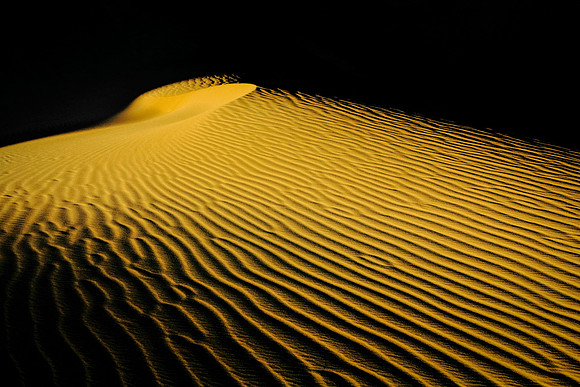
Here is a capture from Mesquite Sand Dunes, Death Valley National Park, right as the sun rose and was still low enough to cause a long shadow on such small features like the gentle ripples in the sand. And here is a bit more science on the matter…
"Ripples in sand, found on both beaches and dunes, arise whenever wind blows strongly enough over a sand surface to entrain grains into the wind. The subsequent hopping and leaping of these grains is called saltation. Saltating grains travel elongated, asymmetric trajectories: Rising relatively steeply off the bed, their path is then stretched downwind as they are accelerated by drag forces. They impact the sand surface centimeters to tens of centimeters downwind, typically at a low angle, around 10 degrees. It is this beam of wind-accelerated grains impacting the sand surface at a low angle that is responsible for ripples.
An artificially flattened sand surface will not remain flat for long. (Try it on the beach or on the upwind side of a dune and see for yourself.) Small irregular mottles in the sand surface, perhaps a couple centimeters in wavelength, rapidly arise and grow once the wind starts to blow hard enough to initiate saltation. They then slowly organize themselves into more regular waves whose low crests are aligned perpendicular to the wind direction and begin to march slowly downwind. Typical ripple spacing is about 10 centimeters, whereas the typical height of the crests above the troughs is a few millimeters. The pattern is never perfect, but instead the ripple crests occasionally split or terminate, generating a pattern that looks remarkably like one's fingerprint. In cross section, the ripples are asymmetric, having low-angle upwind (stoss) faces and steeper downwind (lee) faces. Interestingly, the larger grains tend to accumulate on the crests of the ripples, leaving the troughs enriched in smaller grains." ~ Robert S. Anderson, Associate Professor of Earth Sciences at the University of California at Santa Cruz