Edition Type: Limited-Edition Fine-Art Collectible Edition Size: 50
Edition Price Tier: Tier 3
About My Pricing Edition Print Sizes: 8x10 & above
Original Artist’s Proof: A.P. 1/1 - AVAILABLE & ready to custom print
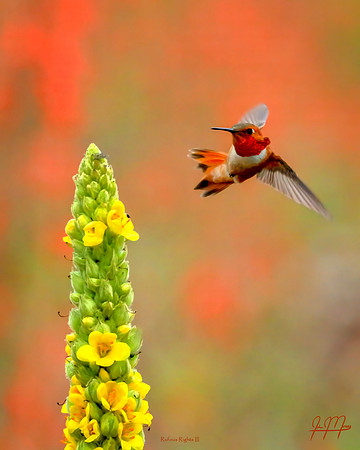
Contact artist for a quote Other Information: Lifetime Warranty & Guarantee Narrative: This is a male Rufous hummingbird, a common bird. The red Penstemon flowers in the background field are also quite common; most normally seen around roadsides or burnt forests. And the Mullen flowering plant being flown over and used as a territorial perch and marker is probably the most common. What is not so common is such a thick and massive concentration of beautiful red penstemon flowers in such a small area, perhaps the size of 40 Sq. Ft., and having a dozen males fighting over it relentlessly...mostly fighting and defending, not so much time drinking the spoils.
The males are constantly fighting and defending over constantly blurred territorial lines. The only thing for sure in this case, is that I will only find males here, because the bounty is so rich and concentrated. Over an hour standing in this field, I only saw one female before she was chased away by several males, and I happened to also see one male of another species, who was also molested upon arrival. When I finished my shoot and walked back 50 feet back to the jeep, there was a little more penstemon, but in sparse quantity without any concentration. Here were only females, in an area twice the size as the former, completely absent of males. There was one female, and every once in awhile another female looking for her boundaries would arrive and they would fight.. There is a reason for all this, and it even creates a physical distinction between males and females in their metabolic rates and the genetic disposition of their relative wing lengths...
Both males and females are territorial; however, they defend different types of territories. The more aggressive males fight to defend areas with dense flowers, pushing females into areas with more sparsely populated flowers. Males generally have shorter wings than females, therefore their metabolic cost for hovering is higher. This allows males to beat their wings at high frequencies, giving them the ability to chase and attack other birds to defend their territory. The metabolic cost of short wings is compensated for by the fact that these males do not need to waste energy foraging for food, because their defended territory provides plenty of sustenance. Females on the other hand are not given access to the high concentration food sources, because the males fight them off. Therefore, females generally defend larger territories, where flowers are more sparsely populated, forcing them to fly farther between food sources. The metabolic cost of flying farther is compensated for with longer wings providing more efficient flight for females. The differences in wing length demonstrate a distinct sexual dimorphism, allowing each sex to best exploit resources in an area.