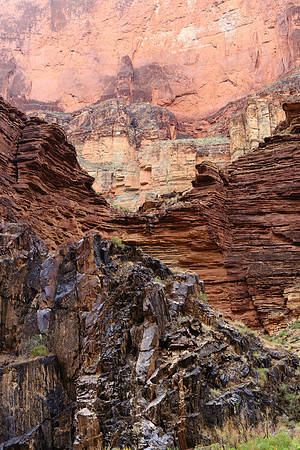
Looking Up Through Time
While floating along the Colorado River in the Grand Canyon, we came into the rock layer known as the Vishnu, a metamorphic rock so incredibly old, it is known as the "Vishnu Basement", laid down about 2 billion years ago. As you look up the side of the canyon, you start to appreciate each of the layers present in the timeline of the canyon's existence. If you are well-studied, then just as important as the layers present in the timeline, are the layers not present, known as "unconformity".
With the Vishnu being about 2 billion years old, the next layer to expect would be the various layers from the Unkar group, which would date between 1.5 billion and 750 million years old. Where this layer is, no one knows. The next layer in view, immediately behind and above is known as the Tapeats sandstone layer, part of the Tonto Supergroup, and on average around 550 million years old, so with this knowledge you begin to really wonder what happened in the 1.5 billion years between the Vishnu and the Tapeats. Maybe it was there at one time and eroded away? Or maybe it was never laid down to begin with in this area?
Next in the far background, you can see the Tapeats give way to two other layers of the Tonto Group: Bright Angel (515 Million years); Muav Limestone (505 Million years). But then again, in another geological gap, more significant time periods are missing. The next two periods of geologic history, the Ordovician and the Silurian, are missing from the Grand Canyon sequence. Geologists do not know if sediments were deposited in these periods and were later removed by erosion or if they were never deposited in the first place. Either way, this break in the geologic history of the area spans about 65 million years. Above this missing era, we then next see the cliff-forming Redwall Limestone layer, between 400-800 feet thick, laid down about 40 million years ago.