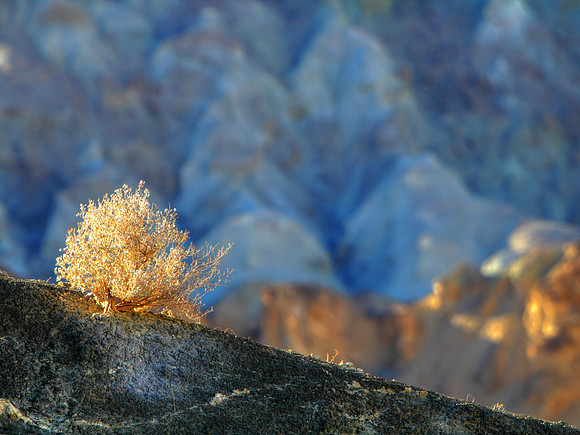
Death Valley Spinich
The common salt bush is often mistaken for "sagebrush". It is actually related to the "tumbleweed", or Russian thistle and is part of the "goosefoot" or "pigweed" family. Common salt bush is a grayish-white shrub that grows to be about 2 to 3 feet tall. It has many branches sprouting from the base of the plant. They aren't very pretty to look at, but they are very well adapted to living in dry, alkaline environments, such as the Mojave desert -- pictured here in Death Valley.
The stems and leaves are covered with small white scales called scurf, that help the plant conserve water. As a matter of fact, the common salt bush doesn't like lots of water. The leaves are sharp spines alternately clustered around the stem of the plant. In extreme droughts it will drop all of its leaves.
It gets its name from the salty deposits on its leaves. When the salt bush takes up water from the salty, alkaline soil of the desert, it removes and deposits the excess salt in bladders on its leaves. This keeps the salt away from the plant cells and also attracts moisture in the air for the plant to absorb. When the leaves are eaten or fall off, the extra salt is removed from the plant.
Common salt bush is sometimes called "cattle spinach". It is very important as a browse plant for cattle and sheep because it is a great source of minerals, especially salt, which they need. This plant is a good source of food and shelter for many desert animals. Barn Owls and Northern Harriers use its branches to perch on. Pronghorn, deer, and many desert rodents eat the leaves as well.